Real materials 23:
Escher-inspired Hexagonal Fish Tessellation in a Handmade Bowl

Matthew Van Atta sent us a photograph of a pottery piece which he made in 2011 from electric-fired ceramic material.
Matthew was from 'wwwway up north in Alaska where men are men, women are women, bears are unreasonably big, and pets are thawed yearly in springtime. Now, he hails from New Zealand at the underside of the planet. New Zealand: where men are men, women are women, sheep are nervous, and many of the kids have cuuuuuurly white haaaaaair?
Nestled snugly into the bottom of the dish is a hexagonal tessellation of stylized fish. Matthew tells us it's an original tessellation based somewhat on an M. C. Escher design which you can see by clicking here.
Matthew writes,
"I plan to use tessellations in my pottery. I am starting a project involving
tessellations as surface decorations of vases. The shaped cylindrical shell
is excellent for ideas that can 'wrap around'.
"The pie plate pictured on this page is an Escher-style piece that I made in 2011.
"Unfortunately a large crack appeared in the glaze firing so I was never
able to make my Escher apple pie.
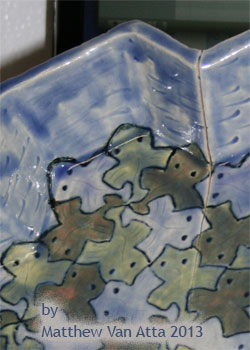 "As a mechanical engineer (yes, I have a degree) I couldn't understand why [the large crack appeared]
for a long time. Today I know how to make the piece without being trouble
by cracks (compressing more and using less filler clay in joints). Here is
the simple reason: thermal expansions, contractions, quartz inversion, and
anisotropic properties of clay. The crack also happened where two slabs
were joined and I am guessing (impossible to say for sure) also aligned
with the general direction of particles in the base."
"As a mechanical engineer (yes, I have a degree) I couldn't understand why [the large crack appeared]
for a long time. Today I know how to make the piece without being trouble
by cracks (compressing more and using less filler clay in joints). Here is
the simple reason: thermal expansions, contractions, quartz inversion, and
anisotropic properties of clay. The crack also happened where two slabs
were joined and I am guessing (impossible to say for sure) also aligned
with the general direction of particles in the base."
Ummmm... that's the "simple reason", Matthew? Only a mechanical engineer with an extra helping of brains would think that "quartz inversion and anisotropic properties of clay" is a simple reason.
|
